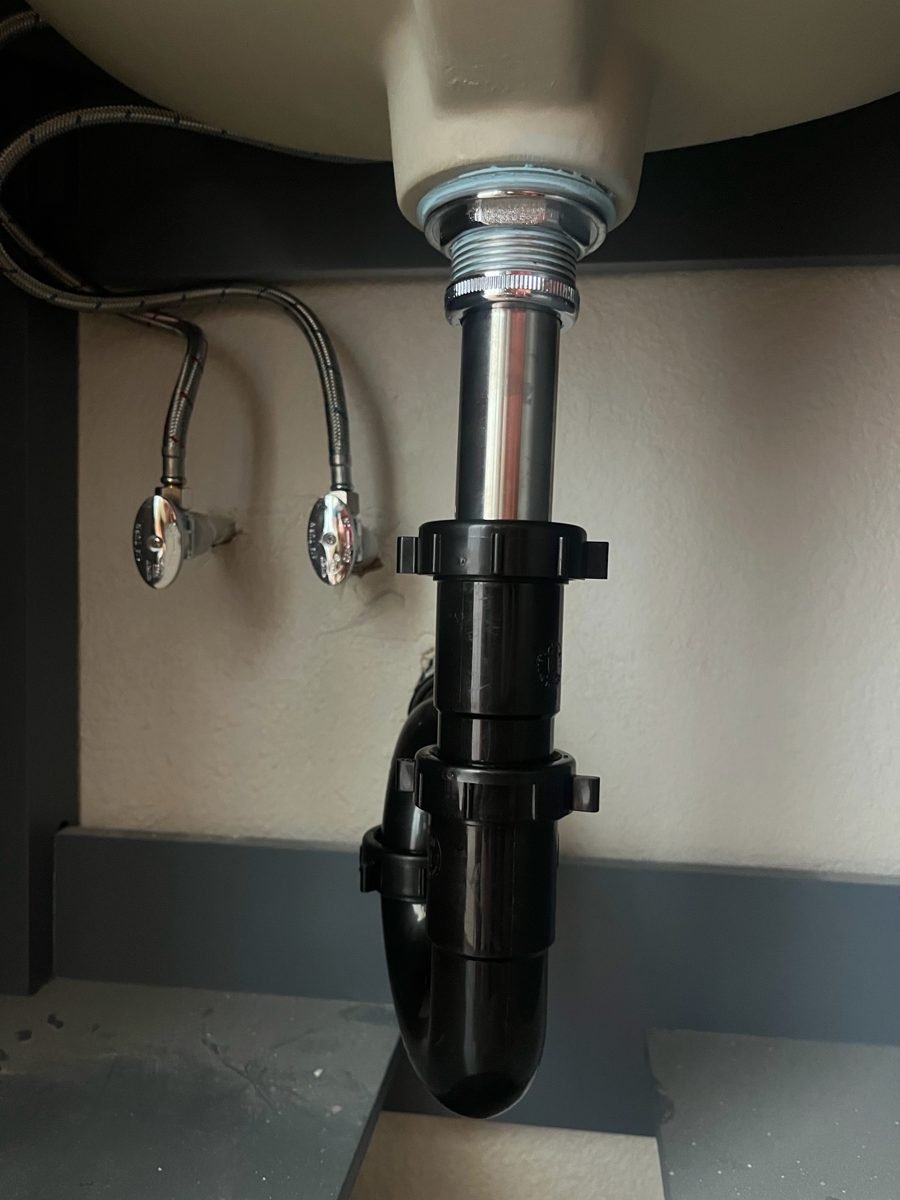
Open the cabinet under any sink in your house. You’ll see one or two small valves coming out of the wall, with braided or plastic lines running up to the faucet. Behind every toilet there’s another one. Those are angle stops. Each one exists for exactly one moment: the day something leaks and you need to shut off the water right there.
In the Las Vegas Valley, hard water means many of those valves don’t work when that day comes. Jason Miller has more than 24 years of plumbing experience, and replacing seized, leaking or snapped angle stops is some of the most common and most worthwhile work he does.
What Angle Stops Do
An angle stop is a small shut-off valve where water comes out of the wall. “Angle” because water comes in from the wall and turns 90 degrees up toward the fixture. “Straight stops” do the same job for lines that come up through the floor.
When they work, you can:
- Stop a leaking faucet or toilet without shutting off the whole house
- Replace a faucet, toilet or supply line without a whole-home shutdown
- Isolate an ice maker or dishwasher line
Why They Fail Faster in Las Vegas
Mineral scale
Valley water is very hard. Inside a valve that sits open and untouched for years, calcium and magnesium build up around the stem and washer. When you finally try to turn it, it won’t budge, or it turns but won’t fully close.
Old compression-style multi-turn valves
Many valley homes built in the 1980s–2000s have multi-turn valves with rubber washers. The washers harden and crack with age, especially in hot cabinets or garages.
Plastic and economy valves
Some builders installed plastic-bodied valves. These can crack when overtightened, or snap when forced after years of sitting.
Old supply lines
Plastic or older braided supply lines connected to those valves are a common source of water damage. A burst supply line under a bathroom sink can release a lot of water fast, especially in a two-story home while you’re away.
Signs Your Angle Stops Need Replacement
- The handle won’t turn, or turns only partway
- Water keeps flowing to the fixture even when “off”
- Drips or crust (white or green) around the stem or nut
- Corrosion where the valve meets the pipe stub
- Plastic supply lines or braided lines that look kinked or rusty at the ends
- You don’t know when they were last replaced (or the house is original)
Don’t Force It
If a valve won’t turn, resist the urge to grab pliers and crank. Forcing an old stop can snap the stem or crack the pipe stub inside the wall. Then you have a small geyser and no local way to shut it off. Know where your main shut-off is before you try anything.
Replacement: What’s Involved
A plumber shuts off the main water, removes the old valve, cleans or replaces the pipe stub as needed, and installs a new valve sized for the fixture. Good practice is to replace the supply line at the same time, since it’s already disconnected and older lines are a failure point too.
Common valve choices:
- Quarter-turn ball valve stops turn fully on or off with a 90-degree turn. They resist seizing much better than old multi-turn valves and are the usual upgrade we recommend.
- Compression stops fit onto copper pipe stubs with a compression ring and nut.
- Push-to-connect stops are useful in tight spaces, depending on the pipe.
When several stops in a house are failing, it often makes sense to replace them all at once: kitchen, bathroom sinks, toilets, ice maker and dishwasher. The main water only has to be shut off once, and you get a home where every fixture can be isolated.
A Simple Twice-a-Year Habit
Once your valves are in good shape, keep them that way:
- Turn each angle stop off and back on, once or twice a year.
- Check for drips at the stem and connections afterward.
- Look at supply lines for bulging, rust or kinks.
- Pair it with another seasonal chore, like changing smoke detector batteries.
Exercising the valves keeps scale from locking them in place.
Frequently Asked Questions
Can I replace an angle stop myself?
Experienced DIYers sometimes do. But you’ll need to shut off the main, and older pipe stubs can be corroded or damaged. If the main valve is also seized, or the stub is soldered, it’s better to call a plumber.
What’s the difference between an angle stop and a main shut-off?
An angle stop controls a single fixture. The main shut-off controls the whole house and is usually in the garage, on an exterior wall, or near the water meter.
Should I replace supply lines at the same time?
Yes. It’s a small part, and old supply lines are a common source of sudden leaks.
My toilet keeps running. Is that the angle stop?
Usually not. A running toilet is typically the flapper or fill valve. But if you can’t shut off the water to fix it, the angle stop needs attention too.
Seized, dripping or plastic shut-off valves? Las Vegas Water Experts replaces angle stops, supply lines, faucets and toilet valves throughout Henderson and the Las Vegas Valley. We’re family owned, licensed, bonded and insured, and available 24/7. Call 702-577-5505. NV LIC# 0095727. Prefer to write? Use our contact page.
Leave a Reply